A maritime safety group analyzes ‘human factor’ of incident reports in a new quarterly e-newsletter.
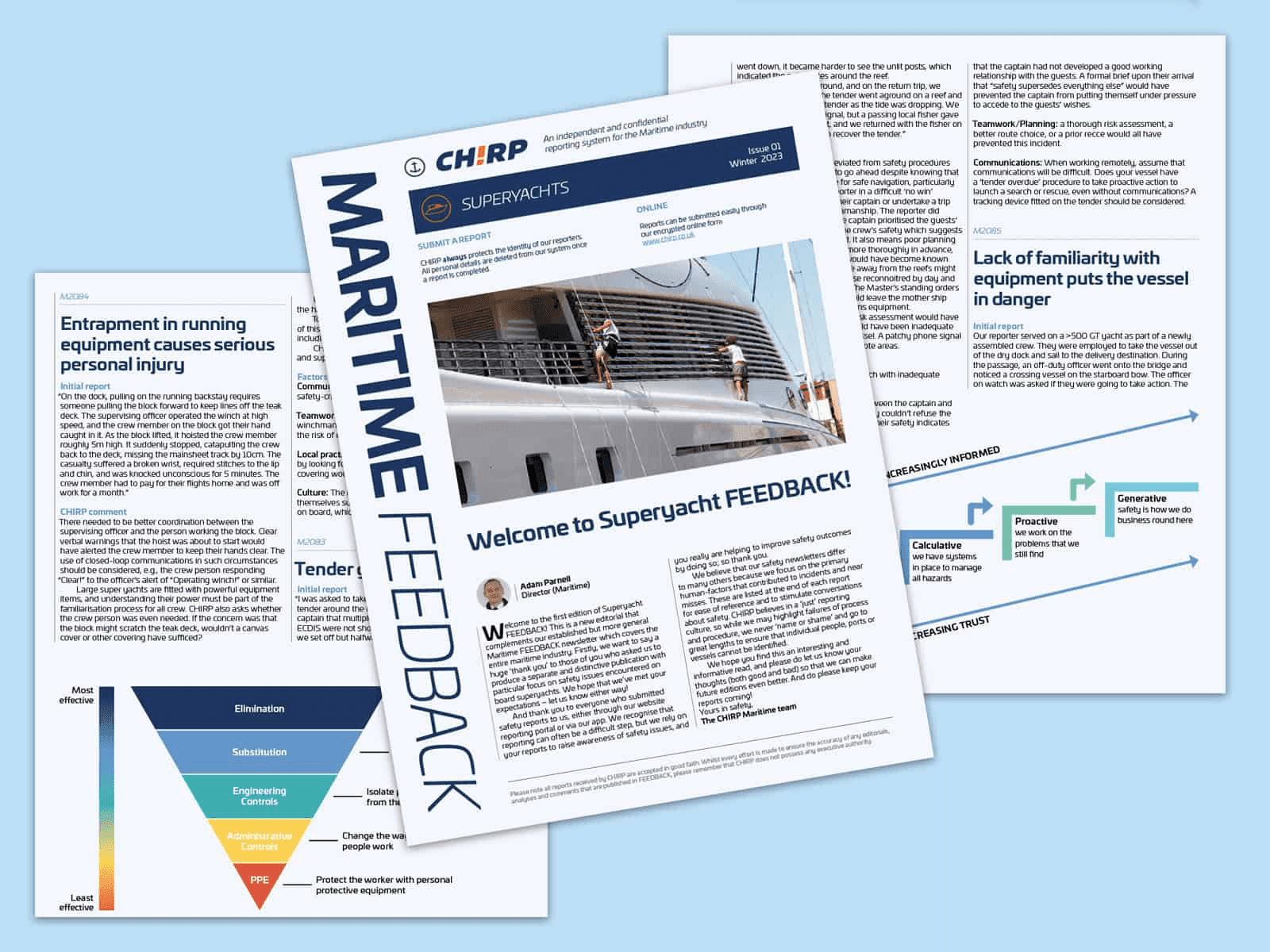
The first edition of “Superyacht FEEDBACK” has hit the digital newsstands! Published by the U.K.-based, not-for-profit, aviation and maritime safety organization CHIRP, the quarterly e-newsletter provides independent, confidential breakdowns of incident reports submitted by yacht crew using an encrypted online form on the CHIRP website or via their app. Although CHIRP has provided this program for 20 years, it’s the first time it has focused specifically on the superyacht sector.
According to CHIRP the group strives for a “just” reporting culture, so while failures of process and procedure may be highlighted, CHIRP reports never “name or shame.” Instead, they go to great lengths to ensure that individual people, ports or vessels cannot be identified.
“CHIRP always protects the identity of our reporters,” stated Adam Parnell, CHIRP’s maritime director. Parnell said the group only retains contact information initially in case they have to gather more information. Once a report has been completed, all personal details and identifying information are deleted from their system.
The program is designed to augment — not replace — company or regulatory reporting programs, and those who report incidents are always encouraged to use official channels if they feel safe doing so. But for those who fear reprisals, such as losing their job, the group will advocate on their behalf.
The reports focus on the human factors that contributed to incidents and near misses in order to stimulate conversations about safety. Their goal, according to Parnell, is to simply raise awareness in the hopes of improving safety outcomes in the future.
For more information or to submit a report, go to www.chirp.co.uk
Here is one incident from the first issue of “Superyacht FEEDBACK,” reprinted with permission.
Maintain control… right to the bitter end
Initial report
A motor yacht was in a maintenance shed while work was carried out on the anchors and chain locker. On the shed floor, a deckhand stood below the hawse pipe to lay out the chain onto a pallet as it was ‘walked out’ on the windlass by a deckhand under the Bosun’s supervision. The plan was to detach the bitter end and then walk it forward on deck so that a messenger line could be attached. However, as the bitter end was walked forward, a bight was created, and this then fell through the hawse pipe under its weight, narrowly missing the deckhand on the shed floor.