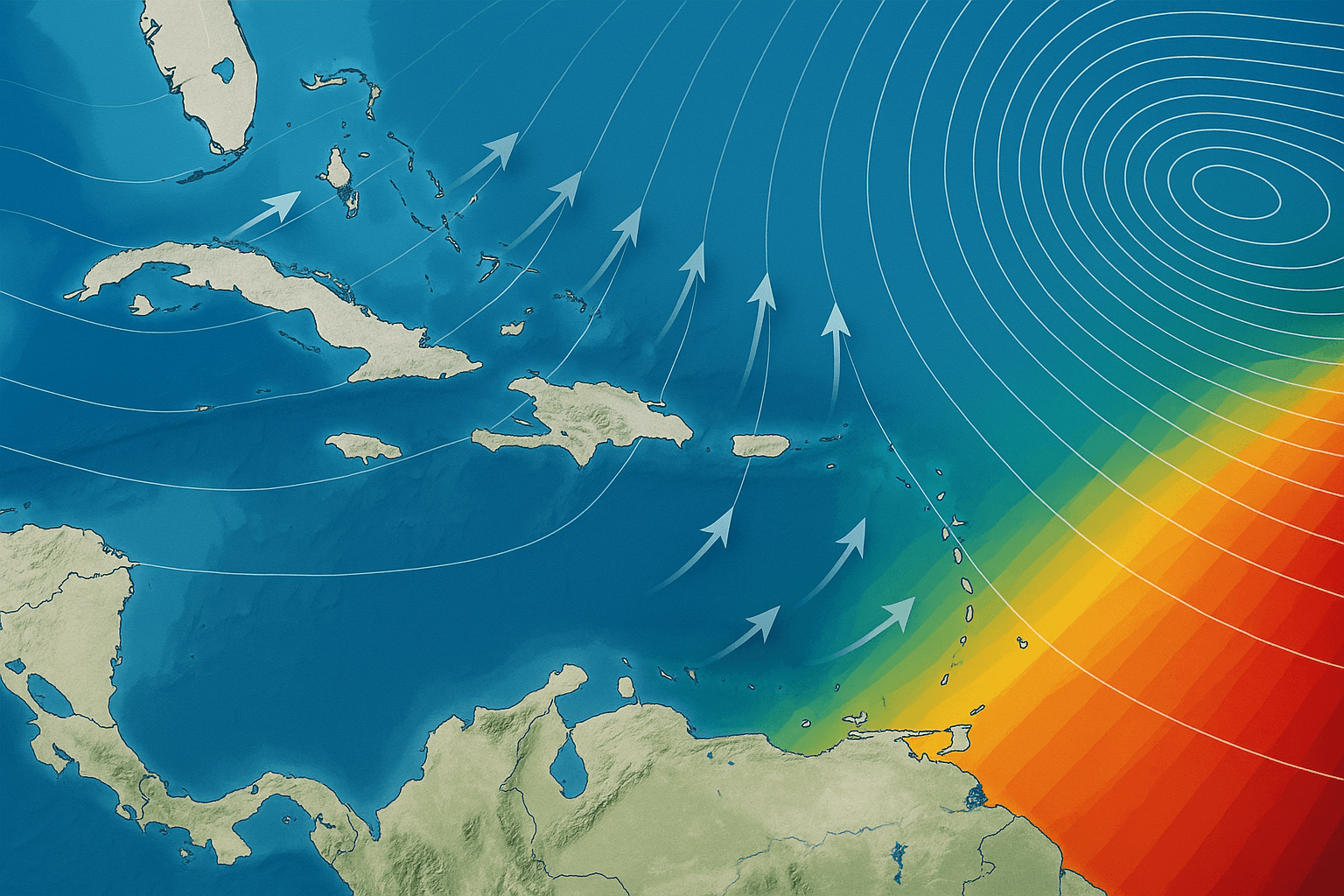
High-pressure ridges such as the one depicted here bring “Christmas trades” to the Caribbean. Larger swells (denoted by the brighter colors) are found in open and exposed areas vs. the lower seas in protected waters on the west side of islands. Graphic courtesy Weather Routing Inc.
Best to seek the lee when “ridges” and “channeling” whip up these Caribbean winds.
Winter is here, bringing thoughts in northern climes of abundant sunshine and warmth. Many yachts escape the chill by heading to the Caribbean, where knowing what is coming your way — namely, in enhanced east-northeast trade winds that are commonplace across this part of the world —and the strategies to employ during those less-than-ideal times is key to a safe, enjoyable experience.
What causes enhanced winter trade winds?
The main driving force is large high-pressure systems, known as ridges, moving off the east shoreline of the U.S. and into adjacent waters of the western Atlantic. These ridges are expansive and will, with time, merge with a large, semi-permanent ridge generally found from north and east of the Caribbean into the central Atlantic. The air masses associated with these transient ridges are cold (though they will modify, of course, as the ridge moves offshore) and the circulation on the south side of the ridge, combined with the colder, more dense air mass it is associated with, gives rise to east-northeast trade winds that generally reach about 15-25 knots across much of the northern and eastern Caribbean.
Localized channeling between islands within far northern and eastern Caribbean waters — the Leeward Islands and Windward Islands, for example — enhances these winds, pushing them into the upper-speed range, with higher periods often reaching minimal gale force of 35-40 knots. Particularly strong ridging across the area in January and February, the heart of the winter season, also is not uncommon, with large ocean swells from the N-ENE often reaching in excess of 10 feet, especially in open and exposed waters.
The passage of cold fronts to the north of the Caribbean in place of ridging will bring a 1-2 day break in these enhanced trades, as winds become east to southeast and ease, also allowing for northeastern swells to abate.